"/><stop offset="1" stop-color="rgb(96, 110, 234)"/></linearGradient><linearGradient id="W2X9EKAmH-2169866396-linear-gradient" x1="0.49751243781094523" x2="0.5024875621890548" y1="0" y2="1"><stop offset="0" stop-color="rgb(120, 70, 175)"/><stop offset="1" stop-color="rgb(96, 110, 234)"/></linearGradient></defs><g fill="transparent" height="6.667790173290786px" id="WxDMP_wo5" transform="translate(0 -0.335)" width="40.000237191183544px"><path d="M 0 6.667 L 0 0 L 40 0 L 40 6.667 Z" fill="transparent" height="6.666666666666666px" id="sESj6aK3L" width="40px"/><path d="M 5.133 1.25 L 5.133 4.583 L 2.933 5.833 L 0.733 4.583 L 0.733 2.083 L 2.933 0.833 L 2.933 0 L 0 1.667 L 0 5 L 2.933 6.667 L 5.867 5 L 5.867 1.667 Z" fill="url(%23SjiByaea2-2169866396-linear-gradient)" height="6.666666666666666px" id="SjiByaea2" width="5.866783625730994px"/><path d="M 0.733 3.333 L 0.733 2.5 L 1.467 2.083 L 1.467 1.25 L 0 2.083 L 0 3.75 L 1.467 4.583 L 2.933 3.75 L 2.933 0.417 L 2.2 0 L 2.2 3.333 L 1.467 3.75 Z" fill="url(%23W2X9EKAmH-2169866396-linear-gradient)" height="4.583333333333334px" id="W2X9EKAmH" transform="translate(1.467 0.417)" width="2.9334035087719315px"/><path d="M 0 3.985 L 0 0 L 1.547 0 C 1.864 0 2.128 0.045 2.342 0.134 C 2.559 0.22 2.733 0.346 2.864 0.513 C 2.994 0.681 3.087 0.883 3.142 1.12 C 3.201 1.357 3.231 1.628 3.231 1.931 C 3.231 2.239 3.203 2.517 3.148 2.766 C 3.097 3.014 3.008 3.23 2.881 3.413 C 2.755 3.596 2.585 3.738 2.371 3.839 C 2.158 3.936 1.891 3.985 1.571 3.985 Z M 0.818 3.308 L 1.524 3.308 C 1.709 3.308 1.86 3.273 1.974 3.203 C 2.089 3.133 2.176 3.036 2.235 2.911 C 2.298 2.783 2.34 2.637 2.36 2.474 C 2.383 2.307 2.395 2.126 2.395 1.931 C 2.395 1.745 2.383 1.575 2.36 1.424 C 2.336 1.268 2.292 1.136 2.229 1.027 C 2.17 0.914 2.083 0.829 1.968 0.77 C 1.858 0.708 1.709 0.677 1.524 0.677 L 0.818 0.677 Z" fill="rgb(255, 255, 255)" height="3.984970760233911px" id="pQ_u90pAO" transform="translate(8.945 1.452)" width="3.231064327485413px"/><path d="M 0 2.999 L 0 0.07 L 0.789 0.07 L 0.789 0.414 C 0.856 0.364 0.939 0.311 1.038 0.257 C 1.136 0.198 1.243 0.146 1.358 0.099 C 1.476 0.049 1.589 0.016 1.696 0 L 1.696 0.753 C 1.593 0.768 1.484 0.795 1.37 0.834 C 1.255 0.869 1.146 0.908 1.044 0.951 C 0.945 0.994 0.86 1.033 0.789 1.068 L 0.789 2.999 Z" fill="rgb(255, 255, 255)" height="2.9989356725146212px" id="HUQJBJ1t7" transform="translate(12.803 2.437)" width="1.6956725146198863px"/><path d="M 1.387 3.057 C 1.051 3.057 0.781 3.003 0.575 2.894 C 0.373 2.785 0.227 2.618 0.136 2.392 C 0.045 2.163 0 1.867 0 1.505 C 0 1.155 0.047 0.871 0.142 0.653 C 0.237 0.432 0.387 0.268 0.593 0.163 C 0.798 0.054 1.063 0 1.387 0 C 1.715 0 1.98 0.054 2.182 0.163 C 2.387 0.268 2.537 0.432 2.632 0.653 C 2.731 0.871 2.78 1.155 2.78 1.505 C 2.78 1.867 2.735 2.163 2.644 2.392 C 2.553 2.618 2.405 2.785 2.2 2.894 C 1.998 3.003 1.727 3.057 1.387 3.057 Z M 1.387 2.415 C 1.553 2.415 1.678 2.386 1.761 2.328 C 1.844 2.266 1.899 2.168 1.927 2.036 C 1.958 1.9 1.974 1.723 1.974 1.505 C 1.974 1.291 1.956 1.122 1.921 0.998 C 1.885 0.869 1.826 0.778 1.743 0.723 C 1.66 0.669 1.541 0.642 1.387 0.642 C 1.237 0.642 1.118 0.669 1.032 0.723 C 0.949 0.778 0.889 0.869 0.854 0.998 C 0.818 1.122 0.8 1.291 0.8 1.505 C 0.8 1.723 0.814 1.9 0.842 2.036 C 0.873 2.168 0.931 2.266 1.014 2.328 C 1.097 2.386 1.221 2.415 1.387 2.415 Z" fill="rgb(255, 255, 255)" height="3.057263157894756px" id="EIrO2_THA" transform="translate(14.828 2.444)" width="2.7804678362573156px"/><path d="M 0 4.224 L 0 0.064 L 0.782 0.064 L 0.788 0.251 C 0.844 0.216 0.913 0.179 0.996 0.14 C 1.083 0.101 1.176 0.068 1.275 0.041 C 1.373 0.014 1.47 0 1.565 0 C 1.964 0 2.251 0.126 2.425 0.379 C 2.599 0.628 2.686 1.007 2.686 1.517 C 2.686 1.883 2.642 2.178 2.555 2.404 C 2.468 2.629 2.328 2.795 2.134 2.9 C 1.945 3.005 1.694 3.057 1.381 3.057 C 1.282 3.057 1.176 3.049 1.061 3.034 C 0.947 3.018 0.856 3.003 0.788 2.987 L 0.788 4.224 Z M 1.257 2.41 C 1.415 2.41 1.539 2.377 1.63 2.31 C 1.721 2.244 1.784 2.145 1.82 2.013 C 1.86 1.877 1.879 1.706 1.879 1.499 C 1.879 1.181 1.834 0.961 1.743 0.84 C 1.656 0.716 1.529 0.653 1.364 0.653 C 1.3 0.653 1.233 0.661 1.162 0.677 C 1.091 0.692 1.022 0.712 0.954 0.735 C 0.887 0.758 0.832 0.782 0.788 0.805 L 0.788 2.369 C 0.836 2.373 0.903 2.38 0.99 2.392 C 1.081 2.404 1.17 2.41 1.257 2.41 Z" fill="rgb(255, 255, 255)" height="4.2241871345029445px" id="azBGUfGeg" transform="translate(18.207 2.444)" width="2.6856140350876103px"/><path d="M 0 2.929 L 0 2.27 L 1.346 0.688 L 0 0.688 L 0 0 L 2.384 0 L 2.384 0.636 L 1.026 2.24 L 2.389 2.24 L 2.389 2.929 Z" fill="rgb(255, 255, 255)" height="2.9289239766081856px" id="GMxU4HuKZ" transform="translate(21.361 2.507)" width="2.3893567251462002px"/><path d="M 1.387 3.057 C 1.051 3.057 0.781 3.003 0.575 2.894 C 0.374 2.785 0.227 2.618 0.136 2.392 C 0.045 2.163 0 1.867 0 1.505 C 0 1.155 0.047 0.871 0.142 0.653 C 0.237 0.432 0.387 0.268 0.593 0.163 C 0.798 0.054 1.063 0 1.387 0 C 1.715 0 1.98 0.054 2.182 0.163 C 2.387 0.268 2.537 0.432 2.632 0.653 C 2.731 0.871 2.78 1.155 2.78 1.505 C 2.78 1.867 2.735 2.163 2.644 2.392 C 2.553 2.618 2.405 2.785 2.2 2.894 C 1.998 3.003 1.727 3.057 1.387 3.057 Z M 1.387 2.415 C 1.553 2.415 1.678 2.386 1.761 2.328 C 1.844 2.266 1.899 2.168 1.927 2.036 C 1.958 1.9 1.974 1.723 1.974 1.505 C 1.974 1.291 1.956 1.122 1.921 0.998 C 1.885 0.869 1.826 0.778 1.743 0.723 C 1.66 0.669 1.541 0.642 1.387 0.642 C 1.237 0.642 1.118 0.669 1.031 0.723 C 0.949 0.778 0.889 0.869 0.854 0.998 C 0.818 1.122 0.8 1.291 0.8 1.505 C 0.8 1.723 0.814 1.9 0.842 2.036 C 0.874 2.168 0.931 2.266 1.014 2.328 C 1.097 2.386 1.221 2.415 1.387 2.415 Z" fill="rgb(255, 255, 255)" height="3.057263157894756px" id="hVOAJWBR_" transform="translate(24.216 2.444)" width="2.7804678362571735px"/><path d="M 0 2.993 L 0 0.064 L 0.789 0.064 L 0.789 0.251 C 0.852 0.212 0.929 0.175 1.02 0.14 C 1.111 0.101 1.205 0.068 1.304 0.041 C 1.407 0.014 1.506 0 1.601 0 C 1.877 0 2.091 0.049 2.241 0.146 C 2.395 0.239 2.504 0.395 2.567 0.613 C 2.63 0.827 2.662 1.114 2.662 1.476 L 2.662 2.993 L 1.867 2.993 L 1.867 1.517 C 1.867 1.315 1.855 1.153 1.832 1.033 C 1.808 0.908 1.763 0.819 1.695 0.764 C 1.628 0.71 1.529 0.683 1.399 0.683 C 1.328 0.683 1.253 0.69 1.174 0.706 C 1.099 0.718 1.026 0.735 0.954 0.758 C 0.887 0.782 0.832 0.805 0.789 0.828 L 0.789 2.993 Z" fill="rgb(255, 255, 255)" height="2.993099415204677px" id="k6aC5HsJY" transform="translate(27.596 2.444)" width="2.6617543859649118px"/><path d="M 1.316 3.057 C 0.988 3.057 0.727 3.003 0.533 2.894 C 0.344 2.785 0.207 2.62 0.124 2.398 C 0.042 2.176 0 1.898 0 1.564 C 0 1.202 0.051 0.906 0.154 0.677 C 0.261 0.447 0.415 0.278 0.616 0.169 C 0.818 0.056 1.067 0 1.363 0 C 1.802 0 2.132 0.109 2.353 0.327 C 2.579 0.545 2.691 0.889 2.691 1.359 L 2.656 1.791 L 0.794 1.791 C 0.798 2.009 0.844 2.172 0.931 2.281 C 1.018 2.39 1.168 2.445 1.381 2.445 C 1.504 2.445 1.638 2.443 1.784 2.439 C 1.931 2.431 2.075 2.423 2.217 2.415 C 2.363 2.408 2.488 2.4 2.591 2.392 L 2.609 2.935 C 2.51 2.95 2.385 2.968 2.235 2.987 C 2.085 3.007 1.929 3.022 1.767 3.034 C 1.609 3.049 1.458 3.057 1.316 3.057 Z M 0.794 1.295 L 1.903 1.295 C 1.903 1.031 1.86 0.846 1.773 0.741 C 1.69 0.636 1.553 0.583 1.363 0.583 C 1.178 0.583 1.035 0.638 0.937 0.747 C 0.842 0.856 0.794 1.039 0.794 1.295 Z" fill="rgb(255, 255, 255)" height="3.0572631578947593px" id="HWRgQ4Zqc" transform="translate(30.819 2.443)" width="2.691461988304269px"/><path d="M 0 3.985 L 1.031 0 L 2.46 0 L 3.486 3.985 L 2.668 3.985 L 2.442 3.18 L 1.026 3.18 L 0.812 3.985 Z M 1.156 2.532 L 2.324 2.532 L 1.867 0.653 L 1.619 0.653 Z" fill="rgb(255, 255, 255)" height="3.984970760233911px" id="FKU8sIkPM" transform="translate(35.19 1.452)" width="3.48608187134505px"/><path d="M 0 3.985 L 0 0 L 0.818 0 L 0.818 3.985 Z" fill="rgb(255, 255, 255)" height="3.984970760233918px" id="dMjn7rx8Q" transform="translate(39.182 1.452)" width="1px"/></g></svg>)

Introduction
An AI can write a working exploit for a freshly published CVE in about fifteen minutes for roughly a dollar in compute costs. That is the fight you are funding when you spend your next security dollar on more perimeter hardening and faster patching, and it is a fight you are quietly losing. The moment an attacker gets inside, though, the math of defense flips in your favor. This article shows you why the pre-breach fight is a worthy but losing battle, how the odds reverse once an intruder is on your network, and how an Agentic SOC lets you press that advantage by investigating every alert.
Before the Breach, the Math Favors the Attacker
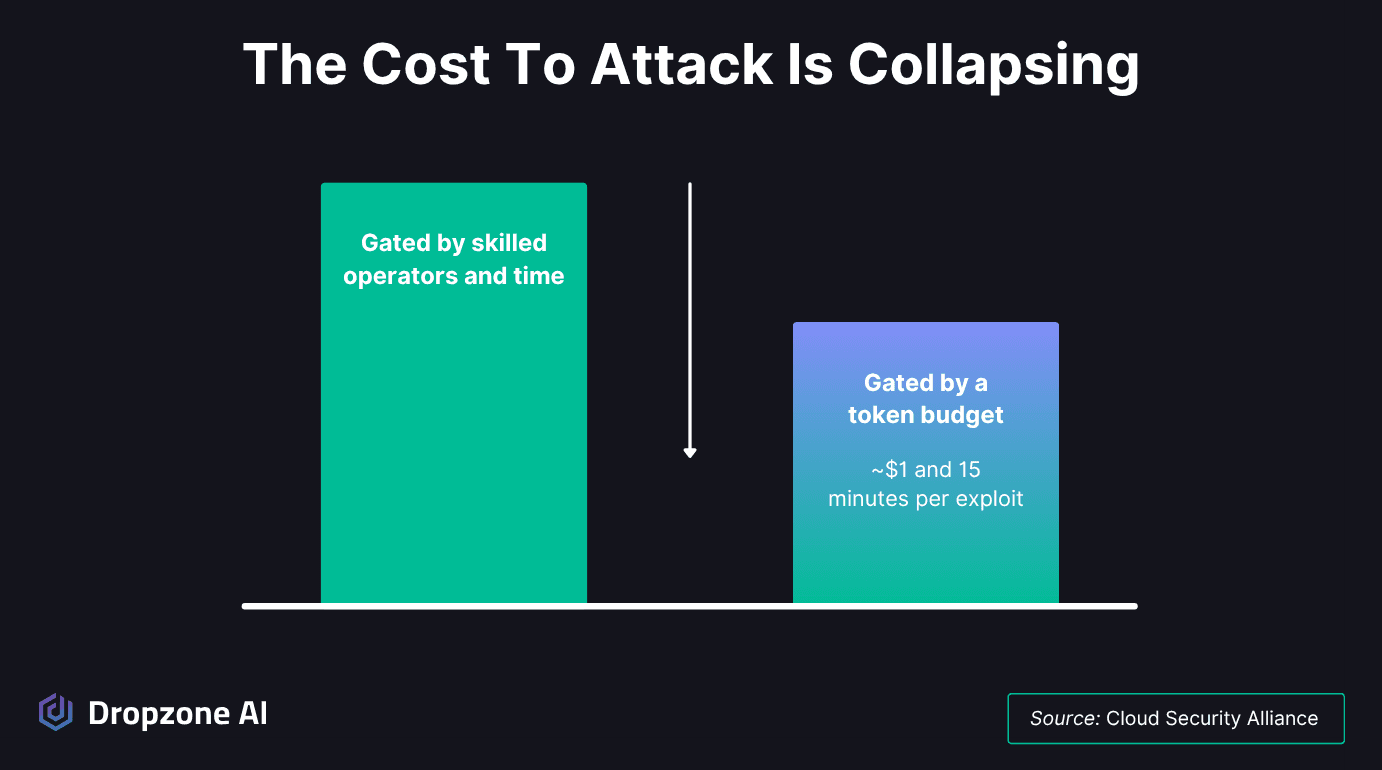
At the point of entry, the attacker has always held the edge, and AI just widened it into a yawning chasm. Attacks used to be limited by scarce skill and real effort so that well-funded nation-states were the only ones able to find and exploit zero-day vulnerabilities. AI removes that skill barrier and drops the cost of getting in significantly for the attacker.
AI Turned Probing Into a Commodity
You already know the old asymmetry at the point of entry. The attacker only has to be right once (the “defender’s dilemma”), and you have to be right every single time. That imbalance has always sat in the attacker’s favor, and nothing about it is new.
What changed was that the cost of trying attacks was limited by the number of skilled operators they could assign to a target and by how long each attempt took. Now they are limited by a token budget, which is a far cheaper constraint, so they can throw a huge volume of attempts at every defense you have, from CVE exploits to phishing to chained low-skill methods, and wait for one to land.
The numbers behind this are not hype. According to theCloud Security Alliance, AI systems can generate working proof-of-concept exploit code for a published CVE in roughly 10 to 15 minutes at about a dollar per attempt, and one framework reproduced 51% of the CVEs published in 2024 and 2025 at an average cost of $2.77 per CVE.
Cheap probing at scale means more attempts, and more attempts mean more initial footholds. This is a step change, not a one-time jump. The capability is still early, and the volume of AI-weaponized vulnerabilities is set to climb over the coming quarters, so the foothold problem gets harder from here, not easier.
Patching Cannot Win a Step-Function Race
Your instinct here is to redouble your preventative security efforts. Preventative security is always a good idea, but it runs into hard walls operationally. Patching carries structural constraints that do not go away, including testing, change windows, compatibility, downtime risk, and coordination costs with IT. No realistic program can get 50 to 100 percent faster at mitigating or remediating the incoming volume of weaponized vulnerabilities.
Mandiant’sM-Trends 2026 found the gap has already gone negative, with mean time-to-exploit dropping to an estimated -7 days and exploitation frequently underway before the vendor has even finished the patch advisory. You cannot close a window by patching faster when the exploit arrives before the fix does.
When you decide where the next dollar goes, a perimeter program that structurally cannot keep pace can’t be your only option. Defense is not hopeless, though, and the ground you can actually win on begins the moment the perimeter fails.
After the Breach, the Math Flips to the Defender
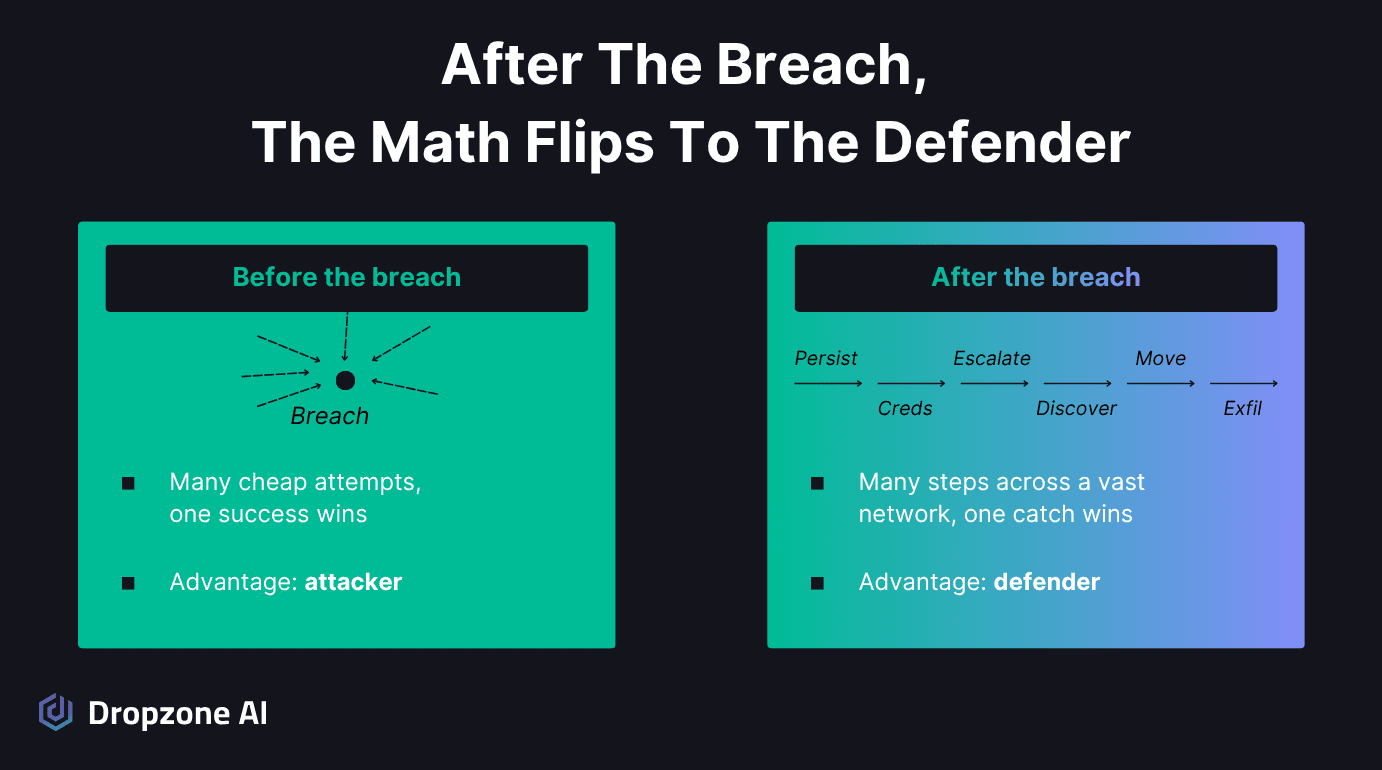
Cross the perimeter, though, and that same asymmetry runs backward. After a breach, the attacker has to complete a long chain of moves undetected to achieve their goals, while you only have to catch one of those moves. This is no longer the “defender’s dilemma” but now the “intruder’s dilemma.” The advantage quietly switches sides, and detection and response become your new front line and your last line of defense.
What Is the Intruder’s Dilemma?
Past the initial foothold, the intruder has to establish persistence, harvest credentials, escalate privileges, discover your crown jewels, move laterally, and exfiltrate the data, all without setting off a single alarm you would notice. Every step is another chance for you to see them.
The inversion is not a Dropzone AI invention. As detection-engineering practitioner David Bianco argued inTechCrunch, the “attacker only has to be right once” maxim describes the point of entry and nothing more, because across the full lifecycle of an attack, the logic inverts, and you only need to detect one indicator to contain the attack.
Put the same idea in plainer terms. Once an intruder is past the vault door, they still have to dodge every motion sensor, infrared beam, and tripwire, and across the half-dozen or more moves that follow, the defender only has to catch one.
The Tell That This Ground Is Defensible
The proof that this ground favors you lies in how attackers behave once inside. They work remarkably hard to stay quiet, and that evasion effort is the tell. Living off the land is now the majority technique for a good reason.
CrowdStrike’s2026 Global Threat Report found that 82% of detections were malware-free, with attackers leaning on legitimate tools like PowerShell and RDP rather than dropping malware that would trigger a detection. Log erasure comes from the same anxiety because the post-breach environment is hostile to them, and they invest heavily in not being seen.
None of that quiet is free for the attacker, and the clock is short. CrowdStrike put the average breakout time, the gap between initial compromise and first lateral movement, at 29 minutes, a 65% jump in speed over the year before, which is exactly why response measured in minutes rather than hours matters. Every hands-on-keyboard technique they use is an admission that a single caught indicator can unravel the whole operation.
How Do You Press the Advantage? Detection and Response at Machine Scale
The post-breach edge only helps if you can actually look at every alert, and for years, teams could not. The queue was too big, so most alerts went uninvestigated. Making threat hunting a regular operational practice will also help defenders press their advantage. An Agentic SOC helps in both regards.
Why Did Defenders Fail to Press the Post-Breach Advantage?
The post-breach advantage has always existed on paper. Defenders failed to press it because the SOC was capacity-starved. The advantage was always real; the queue simply won.
According to the 2025 SANS Detection Engineering Survey, the top two technology problems cited by participants were high false positive rates (64%) and accuracy issues (61%). This low signal in detection output means that SOC queues grow longer and make it hard to spot legitimate attack activity that might be hiding in low-priority alerts.
In a large enterprise, the daily volume runs into the tens of thousands, stack-ranked down to a few hundred criticals nobody can clear in a shift, and the first sign of a breach often hides in the lows, mediums, and informationals that never get a second look.
To survive that volume, teams did the only thing they could and turned detections off. They poked holes in their own detection fabric and ended up walking the network with a telescope strapped to their heads instead of a wide-aperture telescope.
The flip stays theoretical on two conditions. You need detections that actually cover the intruder’s moves, and you need the capacity to read the alert that carries the first sign of the intruder. Detection coverage and analytical capacity were the missing pieces, and tuning alerts off to survive the volume quietly surrendered both.
The Step Function AI Brings to Defense
AI pays off on the detection and response side, not the prevention side, because AI agents lift the analytical-capacity ceiling that kept the queue winning. Dropzone’s AI SOC Analyst autonomously investigates every alert, following the OSCAR methodology and finishing a full investigation in under 10 minutes. The Dropzone AI Threat Hunter pushes that advantage further, making regular hunts possible for even the most resource-constrained teams.
It processes dozens of alerts in parallel and queries your SIEMs and EDRs at once, so nothing sits in the queue unlooked at, and the low and medium alerts that used to be ignored finally get read.
This is an Agentic SOC that expands your capacity rather than replacing your people. Your analysts stay in command, setting scope, authorization boundaries, and business context while owning every verdict, and the agents execute at machine scale.
Alongside the SOC Analyst, an AI Threat Hunter surfaces what you are missing and an AI Threat Intel Analyst flags what threats matter, running as a coordinated team rather than siloed bots, so intel triggers hunts and hunts sharpen investigations. All of it runs complementary to your SIEM rather than against it, since the SIEM detects and Dropzone AI investigates what it surfaces.

Dropzone’s AI Threat Hunter finds threats that never fire an alert.
Freed from the alert grind, your engineers get back the hours to build and tune detections instead of switching them off, widening the aperture they once narrowed just to survive the volume.
Response starts with a confirmed verdict: the agents investigate, and the moment they confirm a threat, auto-containment fires immediately, blocking malicious IPs and disabling compromised accounts to stop the attacker and buy your incident response team time.
Dropzone AI already runs in production across 300+ environments, and one of them, oil producerAssala Energy, now investigates 100% of its alerts with 70% fewer false positives and a 5x faster response on a lean team, which is about as concrete a demonstration of “no alert left behind” as capacity claims get.
Conclusion
Keep hardening the perimeter and keep patching, because both still matter, but betting your organization on that work losing more slowly is not a strategy. The winnable fight begins the moment the attacker is inside, and pressing that advantage now requires the capacity to investigate every alert rather than triage most of them into the void. That is how you even the odds and make your coverage match the threat instead of trailing it.
See what pressing that advantage looks like and walk through real Dropzone AI investigations end-to-end in our live,self-guided demo environment.
Key Takeaways
Access got cheap. AI generates a working PoC exploit for a published CVE in 10 to 15 minutes for about a dollar worth of compute, so attackers are gated by a token budget rather than skilled operators, and more attempts mean more footholds.
The math inverts. Before entry, the attacker needs one win; after entry, they must survive half a dozen or more moves without tripping an alarm, and the defender only has to catch one. This is called the “intruder’s dilemma.”
Prevention is important, but you need layered defenses.Perimeter hardening cannot get 50 to 100 percent faster, but AI agents that investigate every alert lift the analytical capacity ceiling and drop mean time to respond from hours to minutes
" width="32px"><path d="M 10 11.4 L 0 1.4 L 1.4 0 L 10 8.6 L 18.6 0 L 20 1.4 Z" fill="rgb(0, 0, 0)" height="11.400000000000006px" id="WzVcCPzSg" transform="translate(6 10.5)" width="20px"/><path d="M 0 0 L 32 0 L 32 32 L 0 32 Z" fill="transparent" height="32px" id="JnWsCmB6z" width="32px"/></g></svg>)